What is Health?
Health comes from within. Blah blah blah, some new age spiritual buzzwords.
You cannot be healthy if you do not want to be healthy. Health is not just some base level need like food or water or shelter which you need to refresh everyday, but the system within which these needs exist.
Your health is a day by day practice, a month by month habit, and a life-long mission. Faith and virtue are no different from health.
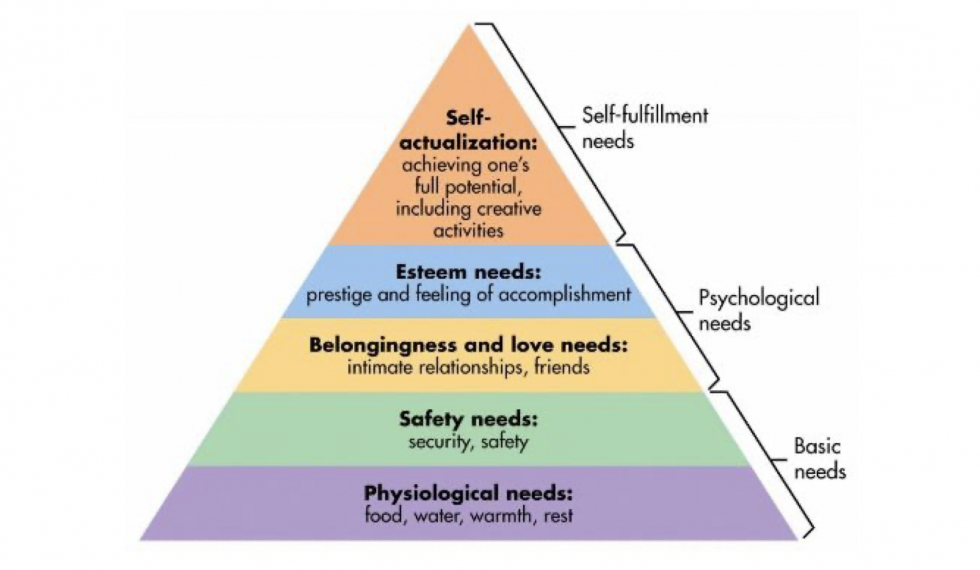
Give me a reason to talk about the hierarchy of needs and I’ll leap at the opportunity. Call it pseudoscientific babble if you’d like, but at least then point to a better model for how we grow. I bet you can’t.
What I’ve had trouble grappling with here is just how exactly we meet our needs, or more specifically, how often. I used to think that we only met the “basic needs” every day, eating three full meals, sleeping in a warm bed, and drinking enough water. However, I’m coming to realize that they are a part of our health, not just physically but emotionally and spiritually. If we want our relationships to flourish, to feel a sense of pride in our work, or to develop deep and lasting relationships with our loved ones, we have to practice these needs daily, form habits that persist beyond months into years, and work for our entire lives.
There’s a beauty in this kind of health. It is temporary, the virtue we cultivate, the heights we achieve, the families we form, the friends we make, the safety we feel and the meals we enjoy. All of it will be gone in the end, but also if it lasts it will be because of the work we do to make it last.
Is health making virtue last? Is it self-actualization before death? Is it not knowing but trying?
Next time I add to this, I’m going to be talking about balancing the humors, blood-letting, and the lapis regia so understand this will be as close to real science as I get here. You cannot be healthy if you do not want to be healthy, and I really have no desire to be interact with the American-processed-slop machine.
Humors, Blood-letting, and the Lapis Regia
I was only really half joking.
If we established last time that health comes from within and a desire to be healthy, I think it’s important to talk a little about what that might look like historically and today. If I had a drug to sell you, I would probably tell you that before modern medicine, we really didn’t know anything at all actually about health and that all doctors wore really badass masks that looked like crows because people thought that birds would carry you to heaven after you got the plague and that the only way to be healthy is by taking a strange mixture of chemicals that you can’t pronounce in pill form… but I don’t sell drugs so I’ll tell you what I actually think.
Before we had the modern scientific process, highly educated doctors, and all the nice rigor that emerged out of Enlightenment thinking we basically had Alchemy, Medicine, and Religion to explain all the wacky stuff that we couldn’t figure out. Of course, medicine took a special role out of the litany of practices within health, science, biology, anatomy and chemistry but in general there was not the rigid systemization that we have today and it’s important to consider the intersection of modern fields within these pre-Enlightenment spheres.
In a nutshell, the old doctors really didn’t understand that biology and psychology were different things, or how the different things in your body affected one another. They came up with theories that spanned across modern disciplines, like psychology and anatomy. One idea was “the humors”: four liquids in your body (blood, yellow bile, black bile, and phlegm) that when unbalanced would also affect your mood and mind. This is actually where we get the word humor from: being “in good humor” would mean your “humors” were properly balanced. Additionally, if one of your humors became “corrupted”, it might become the cause of a disease.
Now, to be crystal clear, knowing what we know now, this stuff is pretty out there. As late as the 1800’s it was written that (from wikipedia):
“The people who have red blood are friendly. They joke and laugh about their bodies, and they are rose-tinted, slightly red, and have pretty skin.
The people who have yellow bile are bitter, short tempered, and daring. They appear greenish and have yellow skin.
The people who are composed of black bile are lazy, fearful, and sickly. They have black hair and black eyes.
Those who have phlegm are low spirited, forgetful, and have white hair”
These kinds of blank-check hypotheses lead to practices like bloodletting, where massive amounts of blood were drained from sick patients in an attempt to, once again, “balance the humors”. George Washington actually died after losing like, half his blood in an attempt to cure him of what was probably a sore throat. That’s a pretty crazy way for the father of our nation to go.
Undoubtedly, this kind of philosophy lead to deaths of error, but on the other hand, did we really know better? Would the doctors besides Washington have been able to cure him, absent a time machine or a magic potion? We still don’t really know what he was ill with, we definitely don’t really know what killed the first president, and that’s the scary thing when it comes to health. We never really know how we’re going to go or why, just that at some point we will.


And that’s why we’ve made up stories about health, and science, and all the things we can’t explain. The Lapis Regia, or the Philospher’s stone, or magnum opus, or one of the half dozen other names I’ve seen, all seem to be this legendary rock of ancient power which grants both immortality and perfect health to the one who possesses it, kind of like the Holy Grail but for alchemy. There’s a funny kind of paradox here that I enjoy immensely. We used to believe that health was about the complicated interplay of liquids in the body, the balancing of emotions as an analogue for the balancing of the body, but also that just a magic stone was the real and actual cure to eternal life and youth.
But maybe there is some truth in that. Bloodletting turned Washington’s evening ride in the rain into the morning he wrote his last will, and yet it was what was tried and trusted at the time. Perhaps if he had held just a bit more faith that a magic rock could cure him he would’ve seen 68.
The same could be said about Steve Jobs, brilliant CEO of Apple, who despite having every doctor in the world at his side urging to take the well trodden path, sought out new and alternative medicines to cure his cancer, possibly costing him his life.
I’m not really arguing here one way or another, and I’m not really sure that would be the point. Health is a constant communication process between the mind, the soul, and the body, and ultimately, where that conversation leads you is your business, not mine.
Still, it’s important to have a story about your health deeper than “Wow my insurance is really expensive, I hope I can keep affording it” or “I eat healthy because I don’t like looking fat, but once I get married all bets are off”. At one point, health was simultaneously the most complicated science, and also the simplest philosophy. Caring about health matters because we believe it matters, not because we want to increase a bottom line at a pharmaceutical company. It is engrained in our cultures, the mixing of science, philosophy, and medicine through alchemy has known roots in Asia, Africa, and Europe, with unknown roots and influences beyond, and it in turn shaped the development of philosophy, religion, and medicine in Europe, around the Mediterranean, and as far away as China. Despite that distance, health is also just taking a few moments to drink something warm and clean, to rest deeply, or to exercise with purpose and passion.
The Grand System
Modern health science is remarkably disciplined. For a field that, just over a hundred years ago, was famously represented by men like Rasputin (infamous for his scandalous influence on the Russian royal family), “Professional Health” today is remarkably well organized, maintained, and accredited. Unfortunately, too much of this organization (in my view) can be attributed to the recession of organized religion and the rise of rationalism, but it would be remarkably short-sighted to deny that science, rationality, logic, and mathematics have formed the pillars that modern health rests on.
Still, for a creed that seems to be so focused on rationality, proofs, and experimentation, a truly shocking number of people are totally ignorant as to what “health” consists of. What percentage of people do anything more with drugs than take the ones doctors prescribe them? How many people understand a diet before beginning one? Why do health professionals undergo some of the most intense education, but there’s so little education for health consumers?
My theory is that our cultural understanding of health is so shallow because health is actually SUPER abstract. The alchemists pointed to this with their bizarre theories about mind and soul and body and bile and blood and phlegm and rocks and gold. At a very, very, abstract level, health is about energy. I am going to try and take this total abstraction and put it in scientific terms that I hope everyone can understand, in an attempt to bridge the scientific, the spiritual, and the mystic. Let’s go!
Thermodynamics (I promise physics is important)
I know I promised no real science, but this is important! I’ll try and keep it simple, and explain all the concepts in clear and basic language. If this is still too much, whenever you see the word “thermodynamics” replace it with the word “alchemy” and it’ll still make sense.
The first law of thermodynamics states that energy cannot be created or destroyed, only transformed from one form into another. This is a profoundly simple statement. There’s no wonder it has served as the basis for some great fantasy and science fiction, but also for modern economics, which is a different type of fantastical fiction.
What the law basically means is that all systems do not increase or decrease in total energy when taken on their own. Whether economic systems, political systems, or ecological systems, the first law states that (so long as the system is isolated) the amount of energy within the system must remain constant. Therefore, for a system to increase or decrease in energy, as those pesky systems tend to do, it must not be isolated.
Of course, this means that our systems, which expend and ingest energy, must have a way of absorbing, retaining, transforming, and emitting said energy. In our bodies, we have lungs and mouths and noses to do the intaking, and pores and other various holes to do the emitting. We call this process “metabolism”, from the Greek word meta (meaning change) and the Greek word ballein (meaning to throw). We can see this in how our body changes food, and then… “throws” it out. This term “metabolism” is most often used when the change occurs in living organisms, but there is no reason we cannot use this principle elsewhere, so long as it remains thermodynamically consistent.
Therefor, the biological process of metabolism, reflecting a physical law, should be scalable upwards in a similar fashion to how it is scalable downwards. For instance, while your body ingests and metabolizes energy to survive, your individual organs and cells participate in the metabolic process of transforming energy. This process allows your body to function and eventually reproduce, but simultaneously the cells of your organs also intake, transform, and expend energy to continue their mitosis. Both you, and your cells metabolize, keeping you and your cells alive. If you died, your cells would stop metabolizing, and if your cells stopped metabolizing, I would go to your funeral and fart loudly.
The metabolic process occurs at every level. Your whole body metabolizes: your individual organs, the cells which make up those organs, the cellular components (like the mitochondria!), and even down to the genes which make up your DNA! Each of these “organisms” intake energy, transform it, and expend it, in different ways and to slightly different ends, but ultimately in the metabolic process of transformation we call life. When your cells die, your body emits them too! This is actually what hair and fingernails are: dead cells being emitted.
So, now that we understand what metabolism is, how exactly does it relate to health? This is where we have to begin to reflect on the history of health, how early doctors and the more serious alchemists connected our physical well-being to our emotional well-being, and give them their dues.
In the body, energy is not created or destroyed, but ingested, processed, and expended. This metabolism has numerous different appearances, from our lungs turning oxygen to carbon dioxide, to DNA using ATP to reproduce and replicate (that’s as complicated as the chemistry gets here, I promise). The same can be said of any system when taken in isolation. It would be absurd to analyze the energy system of the entire Earth, but the thermodynamic law holds true: Earth absorbs its energy from the sun (around 99.97% of it at least), that energy is metabolized by living organisms (photosynthesis anyone?), and then the energy is either re-metabolized or emitted into space, breaking out of the system’s loop.
Energese (also known as Energy System’s Language) is a modeling language used to illustrate the flow of energy in systems. It can be used to model how carbon dioxide moves through our atmosphere, how a computer makes decisions, or even how a basketball pro burns calories.
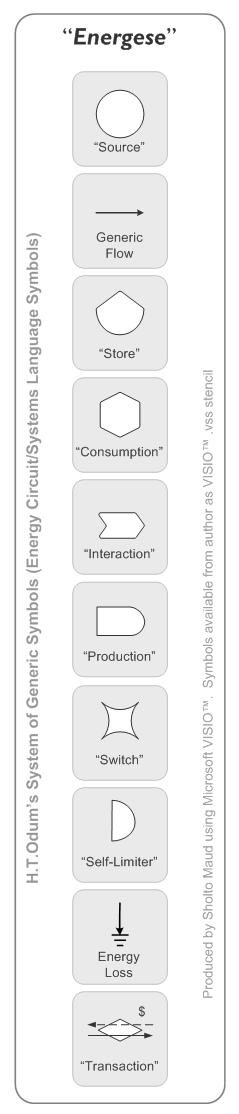
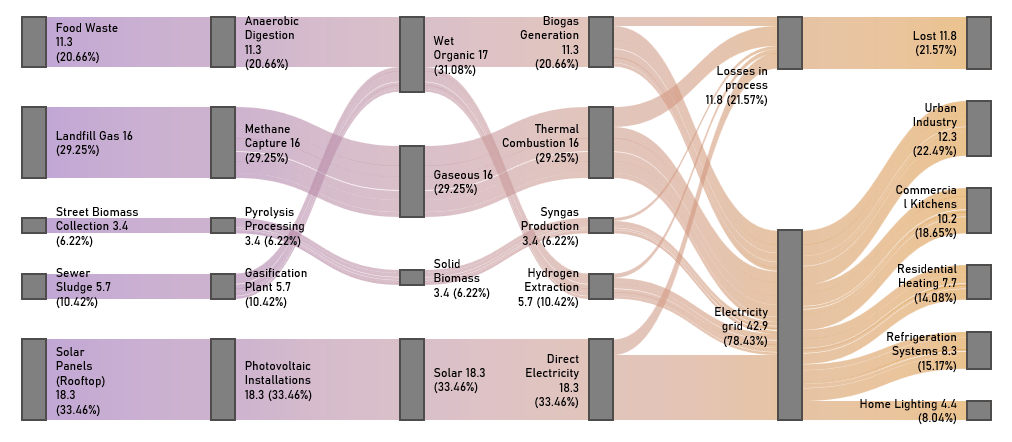
A diagram of energy captured by a city’s energy grid. Energy that is not able to be utilized is emitted by the system, but physically still exists!
The principle for our health is clear: whatever energy the human body absorbs, it must transform and emit. Some human bodies do this more efficiently than others, some bodies do it less efficiently. But all of us do it. We do it for the air we breathe, the food we eat, and the water we drink. But we also transform the ideas we hear.
As humans gain perspective we determine what kinds of energy we value, and which we want to transform, keep, and expend. When we are young, we spend lots of energy testing out different things, determining how they make us feel, and then choosing whether to do these things again. Dozens of different metabolic systems interact with one another, inside and outside our bodies, and then expend energy to reward the energy transformation accordingly. What is important here is that we, as humans, are like the cells of a great and powerful body. We are grand metabolic systems, constantly reacting to the energy expenditure by other apparently “isolated” systems, in a great fabric across the Earth.
For me, this points to two great truths about health.
The first: man is land. There is no life, no energy, no humanity, without a place to grow food to eat. The form of this can change, and morph, from forests to fields to factory farms, but fundamentally, the quality of the energy we intake is dependent upon the quality of the metabolic process of what we are eating. Does this mean that genetically modified food, or livestock kept in horrible conditions is of a lower quality? Not necessarily, but I believe that these conversations are existentially important to our personal health and culture.
The second: energy is life. The way we metabolize energy is a direct reflection of how we treat life. Sustainability is only possible if energy is renewable in its totality. We cannot continue to orient our culture (and our metabolisms) to unsustainable forms of energy consumption. We have become accustomed to a decadent and dangerous consumption pattern, and we must metabolically adjust.
In the next entry I will talk about dinosaurs, the Black Plague, Genghis Khan, and the modern “alchemist” Bryan Johnson.
Three Rhythms
The body is a rhythmic machine. The heart is the easiest rhythm for us to observe. Placing a finger on our wrist, or our hand over our left breast, we can feel the steady way our body measures time. Like the heart, our lungs too are a rhythm, taking one breath for about every four of five beats of the heart. Even during sleep and exercise this ratio remains bounded, with a 3.2:1 ratio and a 6.7:1 ratio being generally accepted extremes.
Combined, the heart and lungs power our days, set our pace, and strengthen our moods. The heart beats the fastest, the lungs breathe at a slower pace, and then even slower still is the sleeping and waking cycle. While perhaps this final connection is a bit tenuous, it is still a fundamental rhythmic process in each and every person’s life.
In order to preserve our bodies’ normal health and functions, our rhythms require consistency. In the manner by which a march, a drum beat, or an oar’s paddling are made less potent without a consistent rhythm, so too must the body be disciplined for its proper functioning. Therefore, the disciplining of the body’s rhythms is perhaps the most important task of the mind. It is the measure by which work, leisure, and even reproduction all occur. With the modern complexity of the daily routine, we can see how technologies like the personal clock, calendar, and alarm all keep a culture of rigid discipline. The complexity of our modern system requires the systemic disciplining of human rhythms.
This can be seen clearly in how highly successful individuals are often the ones who have best disciplined their rhythms through appropriate and yet rigorous levels of exercise, sleep, and stress management.